
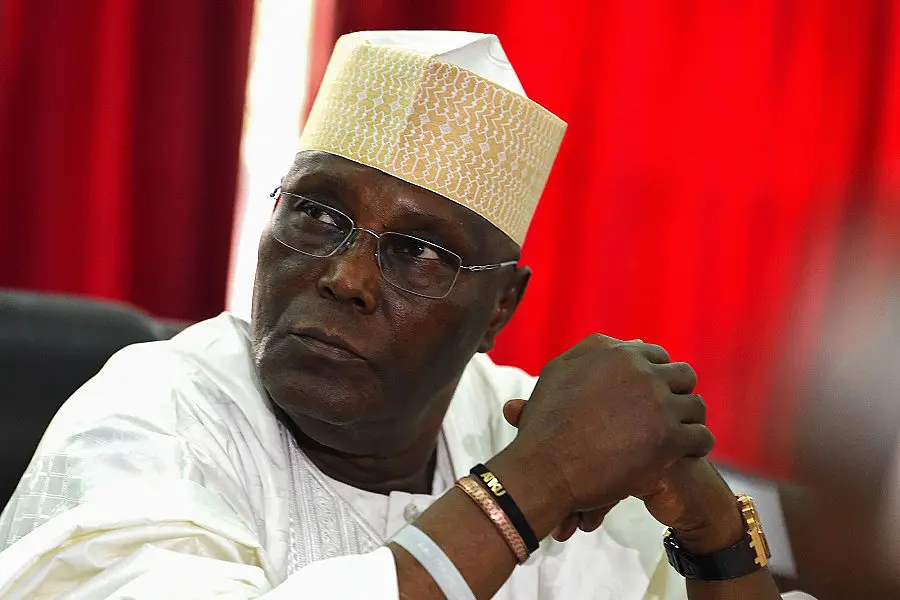
Former Vice President of Nigeria, Atiku Abubakar, has called for the immediate suspension of the Nigerian National Petroleum Company Limited (NNPC Ltd.) agreement with Chinese firms over plans to restart the Port Harcourt and Warri refineries.
Atiku made his position known in a statement released on Friday through his media aide, Phrank Shaibu.
The reaction follows NNPC’s recent announcement of a partnership with two Chinese companies—Sanjiang Chemical Company Limited and Xingcheng (Fuzhou) Industrial Park Operation and Management Co. Ltd.—to support the rehabilitation and restart of Nigeria’s refineries.
Atiku described the deal as risky and warned that it could further damage Nigeria’s economy. He accused the current administration of handling key national assets through unclear arrangements that lack transparency, proper technical assessment, and public accountability.
He also expressed concern over the amount already spent on refinery repairs, saying more than $2.5 billion has reportedly gone into failed rehabilitation efforts without results.
According to him, it is troubling that NNPC is again engaging in another partnership without clear evidence of strong technical capacity or proven experience in refinery operations.
Atiku specifically questioned the role of Sanjiang Chemical Company, explaining that while the firm operates in the petrochemical industry, it mainly focuses on chemical production such as surfactants, methanol-related products, and light hydrocarbon processing.
He stressed that such activities are not the same as operating large crude oil refineries like those in Port Harcourt and Warri, which require heavy industrial refining expertise.
He further stated that there is no public record showing that the company has ever built or managed a full-scale refinery of such complexity.
Atiku also raised concerns about the second firm, Xingcheng (Fuzhou) Industrial Park Operation and Management Co. Ltd., saying available information suggests it is mainly involved in industrial park and infrastructure management rather than petroleum refining or engineering.
He argued that handing refinery rehabilitation to such companies is like giving a highly technical medical operation to a firm that only builds facilities, not one that provides specialized treatment.
The former vice president questioned why the government and NNPC are not working with globally recognized refinery engineering firms with proven experience, instead of choosing companies whose technical background is unclear.
He warned that Nigeria risks repeating past failures if transparency and proper technical evaluation are not applied in the process.
Atiku also criticized the repeated spending on refinery rehabilitation over the years, describing it as a cycle of failed promises and poor accountability.
He said Nigerians should not be asked to accept another agreement that lacks clear technical justification, especially after years of unproductive maintenance projects.
He therefore demanded full disclosure of the agreement, including the terms of the memorandum of understanding, detailed technical assessments of both companies, and clarity on the financial obligations of the Nigerian government.
He also called for open competition involving reputable global refinery operators and urged the National Assembly to investigate previous spending on refinery repairs.
Atiku concluded that national assets like the Port Harcourt and Warri refineries are too important to be handled through unclear or unverified arrangements, insisting that transparency and competence must be prioritized.