
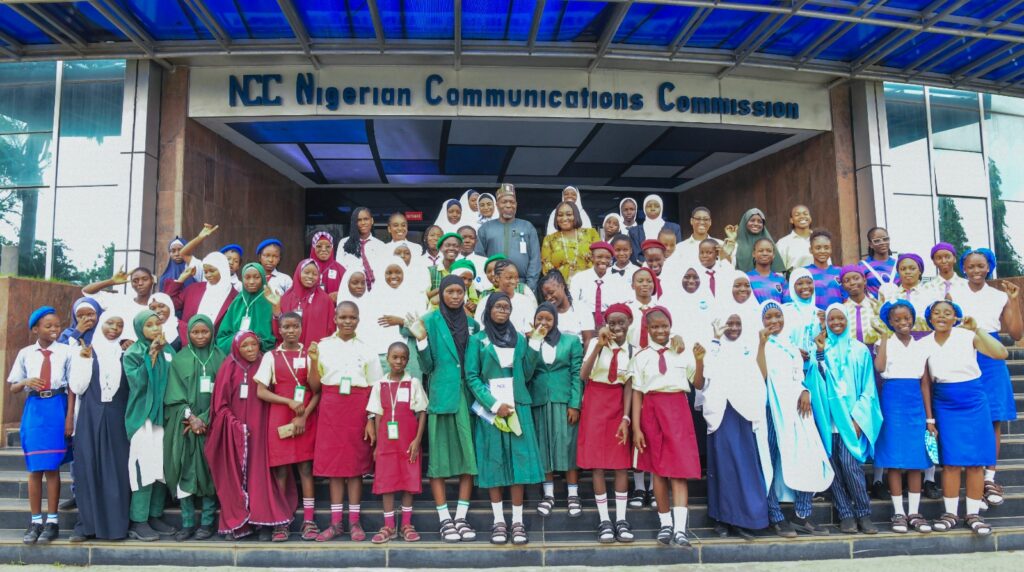
The Nigerian Communications Commission (NCC) has praised the Minister of Communications, Innovation and Digital Economy, Dr. Bosun Tijani, for leading efforts to equip young Nigerians—especially girls—with digital skills and technology knowledge.
The commendation was made on Thursday during a guided visit by 185 finalists of the 2026 National Girls in ICT (NG-ICT) Competition to the National Communications Museum located at the NCC headquarters in Abuja.
The NCC Executive Vice Chairman, Dr. Aminu Maida, said the initiative strongly supports the Commission’s push for digital literacy and inclusion across the country.
The students, selected from Nigeria’s six geo-political zones, are part of a national programme designed to encourage more girls to take part in ICT, science, technology, engineering, and mathematics (STEM) fields.
The museum tour is one of the key activities under the National Girls in ICT Programme, which aims to close the gender gap in the technology sector by exposing young girls to innovation, mentorship, and real-life digital experience.
Speaking through the Director of Research and Development, Babagana Digima, the NCC boss explained that the museum was created to connect Nigeria’s past and present in telecommunications, helping young people understand how far the industry has come.
During the tour, NCC officials guided the students through different historical displays showing how communication in Nigeria evolved from early postal services to modern digital systems.
According to the Commission, learning about this journey is important in shaping future innovators who will drive Nigeria’s digital economy.
Dr. Maida said the goal is to spark curiosity in young minds by showing them how communication technology has developed over time.
He explained, “We want young people to understand where communication started from and how it has grown into what we have today. When they see the past, it helps them imagine the future.”
The students were also taken through key milestones in Nigeria’s telecom history, starting from 1886 when early communication systems were introduced during the colonial era for administrative use.
They learned about early telegraph systems that connected Lagos to other parts of West Africa and Europe through submarine cables.
The tour also covered Nigeria’s telecommunications situation at independence in 1960, when the country had just 18,724 telephone lines serving about 40 million people.
Students were also introduced to major developments such as the former Post and Telecommunications Department (P&T), Nigerian External Telecommunications (NET), and the creation of NITEL in 1985.
One of the major highlights of the visit was the display of rare communication equipment preserved in the NCC Museum, including old postal counters, sorting racks, leather mail bags, telegram machines, teleprinters, and early telephone systems that show how far technology has advanced in Nigeria.